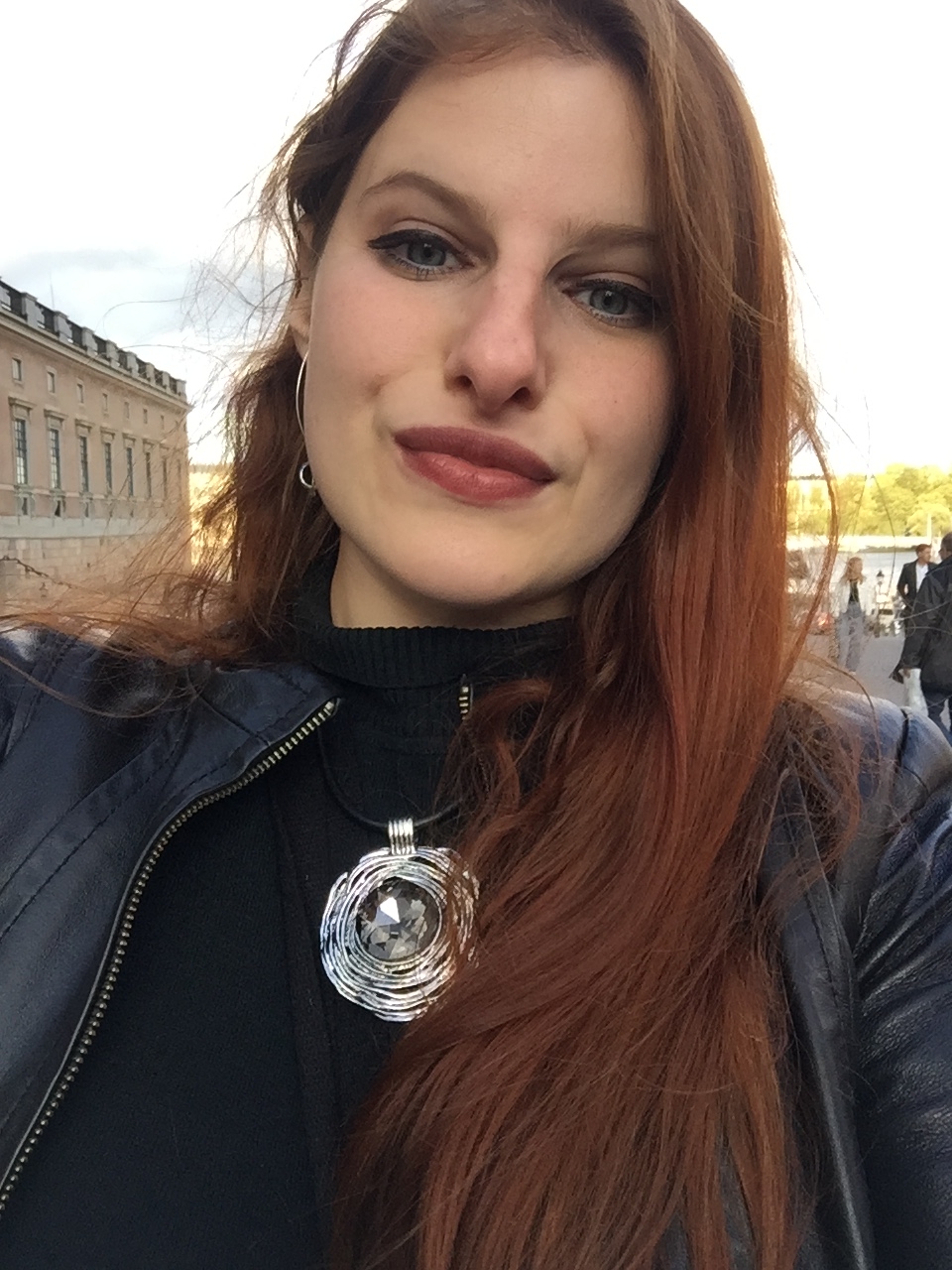
Dr. Anna Maria Matziorinis
PhD in Cognitive Neuroscience
Founder and Director, Hidden Information Labs Institute
About
I am a cognitive neuroscientist, researcher, and the founder and director of Hidden Information Labs Institute, a federally incorporated nonprofit research institute based in Canada. I study the connective tissue of society: the ties that hold families, relationships, workplaces, institutions, and systems of public care together, and the social ripple behaviors that travel along them, the ways emotion, strain, and conduct pass from one person to the next. The work synthesizes network science, computational neuroscience, dynamical systems theory, and behavioral research to make visible the structural dynamics beneath human relationships and social systems.
This work started in the brain. My doctoral research focused on brain aging, neurodegeneration, and the neural processing of music. I studied how brain networks lose structural connectivity in Alzheimer's disease, how that fragmentation degrades cognition and behavior long before clinical symptoms appear, and how interventions like music and physical activity can protect neural network integrity. Years of neuroimaging work on structural connectivity gave me a direct view of what happens when a network breaks down: the nodes are still there, but the edges degrade, information stops flowing where it needs to go, and the system loses coherence from within. The damage is architectural before it is symptomatic.
That same pattern appeared at a larger scale in healthcare systems. I studied how fragmented care networks fail patients: disconnected providers, siloed information, broken referral pathways, and coordination failures that produce worse outcomes even when every individual node in the system is performing competent work. The problem was never the people. It was the network architecture between them. Fragmentation in the brain and fragmentation in healthcare systems followed the same structural logic. A network does not fail because its nodes stop working. It fails because the connections between them can no longer carry the right information to the right place at the right time.
The question at the center of my current work came from extending that observation one more step. If neural networks and institutional networks follow the same principles of connectivity, information flow, and structural failure, then social networks do too. The relationships people live inside, the families, friendships, workplaces, and communities that shape their daily cognition, operate as networks with measurable topology. When those networks fragment, distort signals, or centralize control, the effects on the individual are as real and as patterned as what I had observed in brain scans and healthcare systems. Studying social ripple behaviors applies the same structural lens to relational life that neuroscience applies to the brain and systems science applies to institutions.
The work draws on published research from network science (Burt, Granovetter, Barabasi), social contagion and emotional spillover (Hatfield, Barsade, Westman, Christakis and Fowler), neuroscience (Eisenberger, Barrett, Porges), dynamical systems and chaos theory (Strogatz, Lorenz, Leonov and Kuznetsov), information theory (Shannon, Kolmogorov), thermodynamics and entropy (Prigogine, Jaynes), and behavioral neuroscience (Ferster and Skinner, Festinger). The original contribution is the synthesis: showing that signal distortion across relational ties, hidden attractors, structural holes, predictive processing, channel noise, and entropic drift describe the same relational mechanics observed from different disciplinary vantage points. A boundary violation is a signal-to-noise problem. A coercive network is a low-entropy attractor. A reciprocal edge is a channel with high mutual information. These are the same phenomena measured in different units. The translation of that synthesis into applied tools, protocols, and public education is the work of the institute.
Research Focus
My research investigates how network architecture shapes cognition, relational dynamics, and collective behavior. I apply methods from computational neuroscience, network science, topological data analysis, and dynamical systems modeling to study:
- Structural Literacy and Relational Systems: How network topology determines what individuals can perceive, express, and access within their social systems, and how structural position is often misread as personal character.
- Social Ripple Behaviors: How emotion, strain, and conduct travel along relational ties, how signals return distorted as they pass through a network, and how repeated distortion cycles overwrite an individual's access to their own data.
- Brain Networks and Neurodegeneration: Structural connectivity changes in aging and Alzheimer's disease, the neuroprotective effects of music and physical activity on neural network integrity, and what brain network fragmentation reveals about network failure at every scale.
- Healthcare System Fragmentation: How disconnected care networks produce coordination failures, information bottlenecks, and worse patient outcomes even when individual providers perform well.
- Collective Intelligence: How social networks produce emergent knowledge and decision-making that exceeds individual capacity, and how network topology determines whether collective intelligence emerges or collapses.
- Neuroethics, Power Dynamics, and Freedom: How network structures produce and maintain asymmetries of influence, agency, and coercion in both neural and social systems.
Applied Work
At Hidden Information Labs, the research pipeline is vertically integrated. I build computational simulations and network mapping applications, write research papers, develop clinical workbooks and educational curricula, run seminars and training intensives, and direct a research residency program. The institute's tools are currently being adopted by clinicians for client-facing work. Each layer feeds the next: the research generates the framework, the framework generates the simulations and applications, the applications generate clinical and educational tools, and the public-facing content builds the structural literacy that makes the work accessible beyond the academy.
The institute's seminar series covers extractionary cycles, relational well-being, boundary neuroscience, and structural pattern recognition. HILI maintains an active public education platform reaching a growing international community through writing, social media, and live instruction.
All applied work is grounded in published research on network structure and social ripple behaviors. It is educational and structural in nature, not therapy, clinical advice, or diagnosis.